
Current Gold Price Trends 2025: Forecast, Key Drivers & Analysis
Gold market trends refer to the shifts in gold prices, demand, and investor sentiment, largely driven by economic conditions, inflation, and geopolitical factors.
In 2025, gold remains one of the most reliable safe-haven assets, especially as global inflation and currency fluctuations push more investors toward precious metals.
What are the current gold market trends? In 2025, gold prices are shaped by rising inflation, central bank gold purchases, and safe-haven demand amid geopolitical uncertainty.
With prices reaching over $3,500 per ounce, many analysts forecast continued strength in the months ahead.
This article explores the latest gold price trends, the key drivers behind them, and forecasts for the global market.
We’ll also cover how central bank policies, investor demand, and macroeconomic shifts impact gold’s long-term outlook.
Whether you’re an investor, trader, or collector, understanding these trends can help you make informed decisions in today’s volatile economy.
By the end, you’ll have a clear picture of where the gold market in 2025 is headed—and how you can position yourself to benefit.
Current Gold Price Trends in 2025
Snapshot of 2025 Price Performance
As of September 2025, gold prices are near historic highs, with spot gold hovering around $3,583 per ounce—just off the record peak of $3,599 set recently.
Year-to-date, gold has surged approximately 37%, continuing its strong performance following a 27% gain in 2024.
This robust rally reflects sustained global demand, especially from central banks and investors seeking protection against inflation and economic instability.
Short-Term Trends in 2025
Gold experienced a notable spike in Q2 2025, propelled by escalating geopolitical tensions and growing expectations for U.S. Federal Reserve interest rate cuts—factors that bolstered its appeal as a safe-haven asset.
Since then, prices have mostly remained elevated, with occasional fluctuations reflecting macroeconomic data and global monetary policy shifts.
Visual Data: Gold Price Movement (Past 6–12 Months)
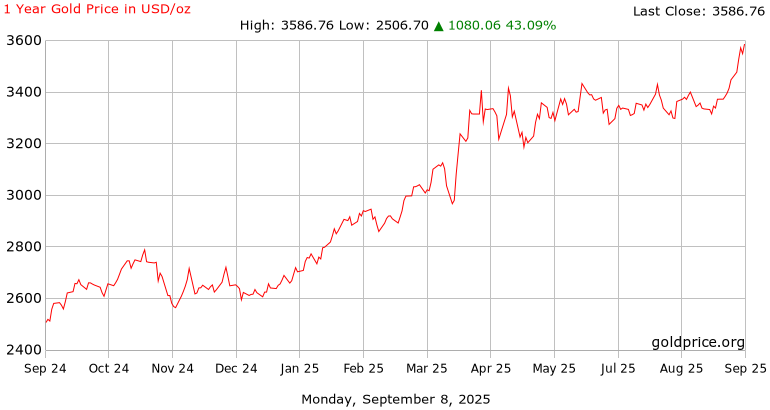
For a comprehensive understanding of the Europe Gold Market Outlook 2025, explore the latest gold market trends, delve into the factors affecting gold prices globally, learn about the impact of the US dollar on gold prices, examine gold demand in China and India, and stay updated with Dubai gold market trends to make well-informed investment decisions.
Monthly Gold Price Overview (2025)
| Month | Approx. Gold Price (USD/oz) |
|---|---|
| Jan 2025 | ~$2,630 |
| Apr 2025 | ~$3,225 |
| Jul 2025 | ~$3,340 |
| Sep 2025 | ~$3,583 |
(Based on aggregated data from exchange-rate platforms and market summaries.)
Key Drivers of Gold Market Trends
Understanding what affects gold prices is crucial for investors in 2025. The following factors continue to shape gold market trends worldwide:
Economic Uncertainty and Inflation
-
Inflation Hedge: During periods of high inflation, gold demand rises as investors seek to preserve purchasing power.
-
Recession Fears: Economic slowdowns or stock market volatility push more capital into gold as a stable store of value.
-
Example: In 2025, U.S. inflation averaging above 4% increased demand for gold ETFs and physical bullion (World Gold Council, 2025).
Geopolitical Events
-
Tensions and Conflict: Wars, trade disputes, and sanctions drive safe-haven demand.
-
Example: Tensions in Eastern Europe and the South China Sea in 2025 pushed gold to record highs as investors sought safety.
Central Bank Policies
-
Gold Purchases: Central banks have collectively purchased over 900 tons of gold in 2025, the highest in decades (WGC).
-
Interest Rate Changes: Expectations of U.S. Federal Reserve cuts strengthened gold’s upward trend by reducing the opportunity cost of holding non-yielding assets.
US Dollar Strength
-
Inverse Relationship: When the USD weakens, gold becomes cheaper for foreign buyers, increasing demand.
-
Example: In mid-2025, a 5% drop in the dollar index correlated with gold’s surge above $3,500/oz.
Technological and Sustainable Trends
-
Tech Demand: Gold’s role in electronics, EVs, and renewable energy technologies boosts industrial demand.
-
Ethical Gold Sourcing: Growing interest in responsibly mined and recycled gold adds long-term appeal, particularly in Europe and North America.
Gold Market Forecast for 2025 and Beyond
As we look ahead, expert projections show that gold prices are expected to remain elevated, primarily driven by sustained uncertainty, central bank demand, and weak U.S. policies.
Analyst Forecasts:
-
Goldman Sachs updated its year-end 2025 forecast to $3,700 per ounce, citing strong central bank and ETF demand. In more bullish scenarios, they see prices hitting $4,500 by year-end or $4,000 by mid-2026.
-
J.P. Morgan Research anticipates gold averaging $3,675 in Q4 2025, with further upside in a dovish rate environment.
BullionVault / LBMA analysts project average prices ranging from the mid-$3,000s to as high as $3,679, reflecting bullish sentiment from both institutional and retail investors.
Forecast Table: 2025 Predictions vs. Actual Average Price
| Forecast Source | Predicted Price (oz) | Target Date |
|---|---|---|
| Goldman Sachs | $3,700 – $4,500 | End-2025 / mid-2026 |
| J.P. Morgan | ~$3,675 | Q4 2025 |
| BullionVault / LBMA Analysts | ~$3,679 (revised) | End-2025 |
| Actual Price (Year-to-Date) | ~$3,583 | Sept 2025 |
Risks & Opportunities:
-
Risks: A stronger U.S. dollar, faster-than-expected economic recovery, or delayed rate cuts could restrain gains—some analysts suggest potential corrections from current highs.
-
Opportunities: Continued central bank accumulation, ETF inflows, and persistent inflation would likely propel gold toward—or even beyond—the $4,000 threshold
How to Stay Informed on Gold Market Trends
Staying updated on gold market trends is essential for making informed investment decisions.
Prices can shift daily due to inflation data, interest rate announcements, or geopolitical tensions, so having the right tools and resources at hand is key.
-
Use Market Tracking Platforms: Websites like Bloomberg and TradingView offer live gold price charts and analysis. These platforms allow you to monitor short-term spikes as well as long-term gold price trends.
-
Google Trends: Tracking search patterns for terms like “gold investment” or “gold price today” can reveal how public interest correlates with price movements.
-
Industry Reports: The World Gold Council publishes quarterly and annual reports detailing supply, demand, and macroeconomic drivers—ideal for investors seeking deeper insights.
-
Newsletters and Market Updates: Subscribing to financial newsletters from trusted gold dealers or analysts ensures you receive timely alerts.
-
Social Media Sentiment: Platforms like X (formerly Twitter) and LinkedIn often reflect real-time investor sentiment. For example, spikes in posts about gold ETFs usually coincide with market volatility.
Pro Tip: Bookmark internal resources such as our guide on How to Invest in Gold for a step-by-step breakdown of strategies.
This not only helps you track trends but also positions you to act when opportunities arise.
For a comprehensive understanding of the Europe Gold Market Outlook 2025, explore the latest gold market trends, delve into the factors affecting gold prices globally, learn about the impact of the US dollar on gold prices, examine gold demand in China and India, and stay updated with Dubai gold market trends to make well-informed investment decisions.
Frequently Asked Questions (FAQs)
1. Why are gold prices rising in 2025?
Gold prices are climbing in 2025 due to high inflation, global tariffs, and central bank purchases. Investors view gold as a safe-haven asset during times of economic uncertainty.
2. Is gold a good investment right now?
Yes. With gold reaching new highs in 2025, it remains a strong hedge against inflation and currency weakness. However, investors should balance gold with other assets to manage risks.
3. What factors influence gold market trends?
The key factors include:
-
Inflation and economic slowdowns
-
Geopolitical tensions (wars, trade disputes)
-
Central bank policies on interest rates and gold reserves
-
US dollar strength (inverse correlation with gold)
-
Industrial and sustainable demand (technology and ethical sourcing)
4. How much is gold worth today?
As of September 2025, gold trades at around $3,586 per ounce, with forecasts suggesting it could reach $3,800 by year-end.
5. Is gold better than stocks in 2025?
Gold is more stable than stocks during market volatility but doesn’t generate income like dividends. It works best as a diversifier in a balanced portfolio.
Conclusion
Gold market trends in 2025 are shaped by inflation, geopolitical tensions, central bank demand, and US dollar shifts. With prices hovering around historic highs, gold continues to prove its value as a safe-haven asset and long-term wealth protector.
While risks like storage costs and currency fluctuations exist, the opportunities for investors are significant, especially in a world facing economic uncertainty.
To stay ahead, keep tracking live gold prices with trusted tools like Bloomberg or Kitco, and explore our in-depth [guide on gold investments] to make informed decisions. Whether you’re a first-time buyer or an experienced investor, staying informed is the key to profiting from evolving gold market trends.