
Long-Term Gold Investment Strategies to Grow and Protect Your Financial Future in 2025
Long-term gold investment strategies have proven their worth over decades, offering stability and growth when markets fluctuate.
Gold has delivered 10.6% annual returns since 1971, outpacing inflation by four times—a remarkable track record that underscores its role as a reliable wealth-preservation tool.
In 2025, these strategies are particularly relevant: rising tariffs, soaring national deficits, and escalating geopolitical tensions have driven gold prices up 30% year-to-date, reminding investors that uncertainty often fuels the demand for tangible, resilient assets.
While gold’s recent gains may grab headlines, the real power lies in strategic, long-term allocation. Investors who adopt long-term gold investment strategies focus on diversification rather than speculation.
Gold is not about chasing short-term market spikes; it’s about stabilizing portfolios, reducing risk, and safeguarding purchasing power in an unpredictable financial landscape.
This guide will explore how gold can function as a cornerstone of wealth management. First, we’ll examine the macroeconomic factors that drive gold’s value—such as inflation, currency pressures, and global instability—illustrating why it remains a reliable store of wealth.
Next, we’ll outline practical approaches to incorporating gold into diversified portfolios, covering physical holdings, ETFs, and other investment vehicles.
Finally, we’ll share actionable tips to manage risk, ensuring your gold allocation enhances long-term growth without exposing you to unnecessary speculation.
By understanding these principles, investors can navigate market volatility with confidence. Emphasizing deliberate, long-term planning over reactive trading allows gold to fulfill its role as a wealth-building asset, not just a hedge against uncertainty.
Whether you’re new to precious metals or refining your existing strategy, starting with a clear roadmap is key. to access expert insights, practical strategies, and tools for creating a gold allocation that strengthens your portfolio and positions your wealth for growth.
In times of uncertainty, gold doesn’t just shine—it secures. With thoughtful long-term gold investment strategies, you can turn market turbulence into opportunity, ensuring your portfolio remains resilient and positioned for lasting success.
The Enduring Appeal of Gold as a Long‑Term Asset
Gold’s Historical Performance and Role in Portfolios

For investors focused on long‑term gold investment strategies, gold has played an important role as a store of value: an asset that doesn’t generate income like a business or bond, but helps preserve purchasing power and diversify risk.
According to the World Gold Council (WGC), gold “is a clear complement to equities, bonds and broad‑based portfolios … a store of wealth and a hedge against systemic risk, currency depreciation and inflation.”
One of the key diversification attributes is its low correlation to stocks. While exact figures vary, many studies place the correlation coefficient between gold and equities at around 0.25 in recent decades — meaning that when stocks struggle, gold may behave differently (though not perfectly anti‑correlated).
Here’s a comparative performance snapshot:
| Period (1971–2025) | Approx. Annualised Return – Gold* | Approx. Annualised Return – S&P 500* | Comment |
|---|---|---|---|
| 1971–2025 | ~8.2% p.a. (gold) | ~11.5% p.a. (S&P 500) | Equities have led over long horizon |
| 2004–2024 | ~9.8% p.a. (gold) | ~9.2% p.a. (S&P 500) | Gold slightly ahead in this interval |
*These figures depend on the time window, reinvestment of dividends, and currency used.
While gold may under‑perform equities in extended bull markets, its value becomes apparent during times of inflation and crisis.
For example, during the 2008 global financial crisis, while stocks plunged, gold offered positive returns. Likewise in 2020, amid the pandemic shock, gold surged even as many equities buckled.
In this manner, gold functions as portfolio insurance. It may not replace stocks for growth, but in a diversified portfolio it helps reduce risk, smooth returns, and maintain value when traditional assets falter.
The World Gold Council’s optimisation research finds that adding a gold allocation of 2–10% to well‑diversified portfolios can improve risk‑adjusted returns.
2025 Outlook: Why Now is Prime Time

For investors considering long‑term gold investment strategies, 2025 presents a uniquely compelling backdrop. Several structural and cyclical factors are converging:
-
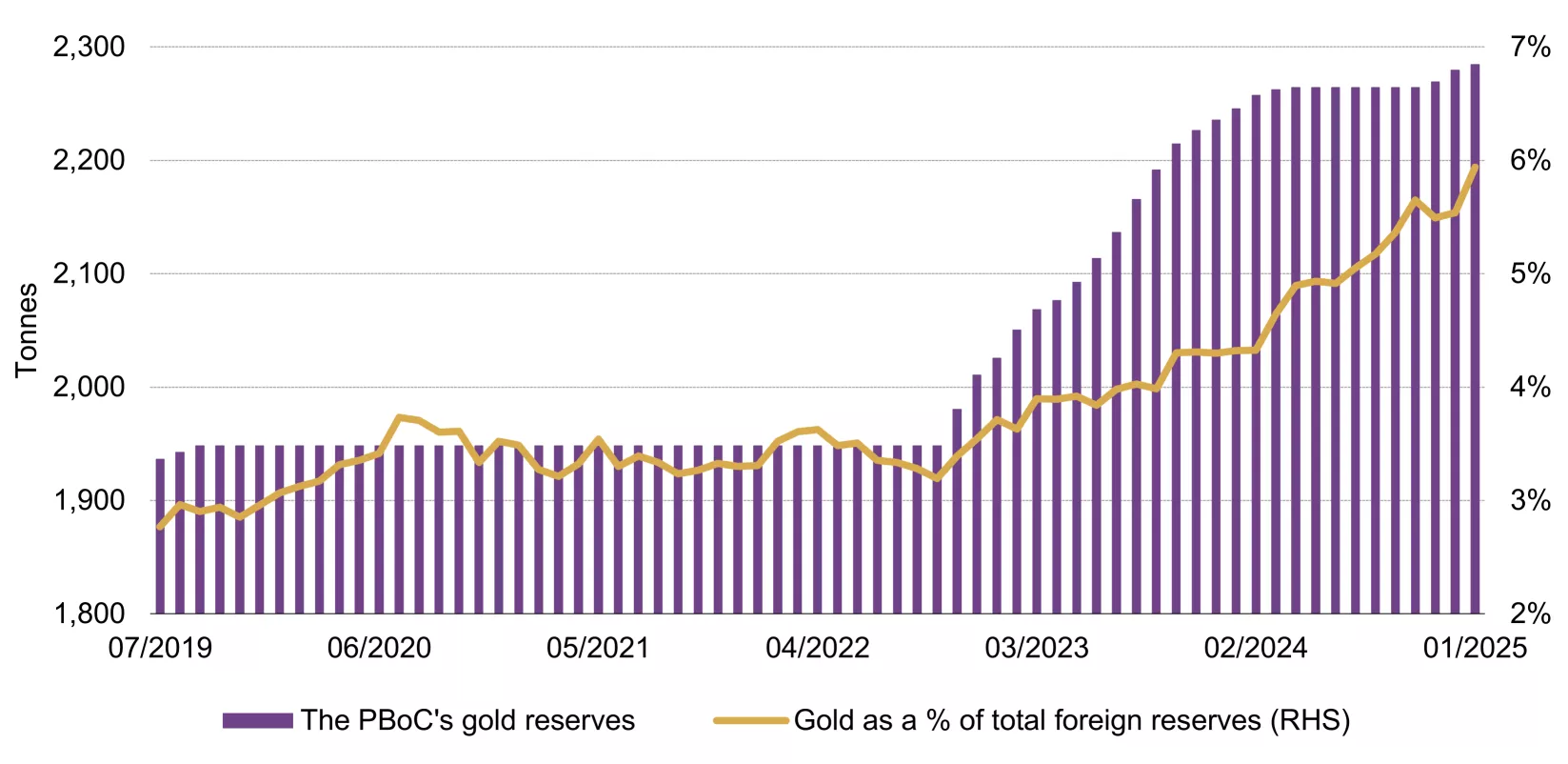
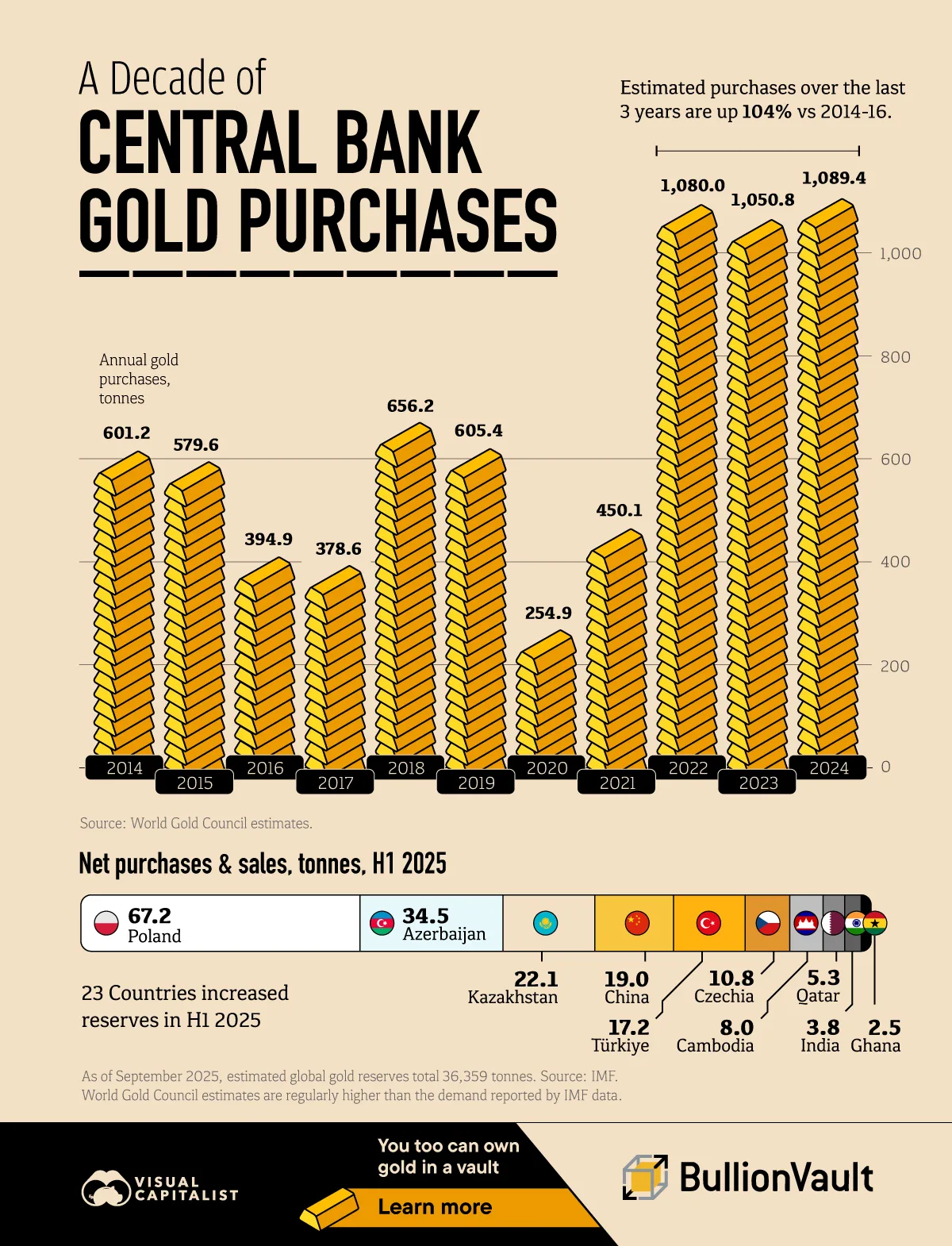
Central‑bank buying: Major central banks, especially in emerging markets, continue accumulating gold reserves. For instance, the World Gold Council indicates optimal allocations for these institutions often fall in the 3–8% range of reserves.
-
Fiscal deficits and currency pressures: Elevated government deficits in many advanced economies raise concerns about inflation, currency dilution and structural risk — all of which tend to support gold’s appeal.
-
ESG / green investor interest: Gold is increasingly perceived not only as a hedge but also as an asset with diversification credentials that fit into ESG‑aware portfolios (given its long‑term store‑of‑value property).
-
Analyst price forecasts rising: For example, Goldman Sachs raised its end‑2025 target to US $3,100/oz, up from earlier estimates, citing strong central bank demand and ETF inflows.
Taken together, these factors mean gold is less a speculative “trade” and more a strategic asset. For investors willing to adopt a long‑term horizon, gold offers a way to anchor portfolio diversification in uncertain times.
In sum, gold’s historical role as a store of value, its modest correlation with equities, and the strength of current supportive forces all make a persuasive case for including it in well‑structured portfolios via long‑term strategies rather than short‑term speculation.

Proven Long‑Term Gold Investment Strategies
Strategy 1 — Dollar‑Cost Averaging into Physical Gold
One of the most disciplined and time‑tested approaches in the realm of long‑term gold investment strategies is dollar‑cost averaging (DCA) into physical gold.
Essentially, instead of trying to time the market, you commit to purchasing a fixed dollar amount of gold (for example, U.S. $500) on a regular basis—monthly or quarterly.
Over time, this smooths out the peaks and valleys of gold’s price swings, reducing the impact of volatility.
Why this works:
-
Gold prices can be volatile in the short term, but over longer horizons tend to reflect inflation, currency pressures and macro risk. DCA takes the guesswork out of “when to buy.”
-
Each purchase buys more gold when prices dip and less when prices rise, averaging your cost per ounce down over time.
-
As a physical asset, bullion coins or bars carry intrinsic value, and can serve as a hedge in a diversified portfolio.
Pros vs. Cons (compared to lump‑sum purchase):
| Feature | Lump‑Sum Purchase | Dollar‑Cost Averaging (DCA) |
|---|---|---|
| Timing risk | High — you might buy at a peak | Lower — spreads purchases over time |
| Cost‑averaging benefit | None | Yes — smooths out entry price |
| Potential for larger gain | If timing is perfect | More modest, but more consistent |
| Simplicity | Simple one‑time action | Requires ongoing purchase discipline |
| Storage & fees | Same physical storage needed | Same storage & annual holding cost |
For example: Imagine committing U.S. $500/month into bullion coins for 12 months. If gold price varies from $1,900/oz → $2,100/oz during the year, you end up buying more ounces when price is low and fewer when price is high, lowering your average cost basis.
“While short-term gold trading focuses on capturing quick market moves, understanding long-term gold investment strategies can help you build sustainable wealth — explore how these approaches complement each other.“
Storage tip:
When holding physical gold long‑term, you’ll want secure storage. You have two main options:
-
A professional vault/depository (recommended for major holdings). Fees are typically around 0.5 %–1 % of value annually (for insurance + security + storage).
-
Home safe storage: cheaper in fees but higher risk (theft, disaster, liquidity).
Whichever you choose, factor the storage & insurance cost into your net return horizon.
Strategy 2 — Building a Diversified Gold ETF Portfolio
For investors who prefer the convenience and liquidity of paper‑assets over physical bullion, employing ETFs is a smart way to execute long‑term gold strategies.
Two standout vehicles:
-
SPDR Gold Shares (ticker: GLD) — which tracks the spot price of gold by holding physical bullion.
-
VanEck Gold Miners ETF (ticker: GDX) — which invests in large‐cap gold mining companies, offering leveraged upside relative to gold prices.
How to build your ladder:
-
Allocate a core holding to GLD for stability and direct bullion exposure.
-
Allocate a smaller portion to GDX (or similar miner‑ETFs) for higher return potential in a gold bull market. In 2025 miners have surged: GDX up ~50%+ YTD, compared to physical gold’s rise.
-
Suggested allocation: For long‑term portfolios consider allocating ~5‑10% of overall portfolio into gold/related ETFs.
-
Rebalance annually to maintain your target allocation (e.g., if equities bounce, your gold share may shrink and should be trimmed or added to).
-
Keep in mind the quote from long‑term investors like Ray Dalio who advocate an “all‑weather” portfolio that includes non‑correlated assets (gold being one of them).
Pros: liquid, easy to buy/sell, accessible for most investors.
Cons: You don’t hold physical metal (in GLD you hold shares, not bars), miners in GDX carry operational & business risk (profit pressure, cost inflation).
Strategy 3 — Gold IRAs for Tax‑Advantaged Growth
A third strategy for those planning long‑term wealth preservation: using a gold‑backed individual retirement account (IRA).
A “Gold IRA” allows you to hold physical gold (and/or approved precious metals) within a tax‑advantaged retirement account.
Setup steps:
-
Choose a self‑directed IRA custodian (for example: Equity Trust Company or other specialised firms).
-
Open the gold IRA and rollover or contribute funds from eligible sources (401(k), traditional IRA, etc.).
-
Select IRS‑approved gold coins or bars that meet purity standards.
-
The gold must be stored in an IRS‑approved depository; you cannot personally take possession without triggering a distribution.
-
Maintain annual fees: custodian fees + storage/distribution fees.
Benefits:
-
Tax‑deferred growth (or tax‑free growth if using a Roth version).
-
Gold’s inflation/market‑risk hedge built into your retirement vehicle.
Drawbacks: -
Higher fees compared to regular IRAs (custodian + storage + insurance).
-
Less liquidity (withdrawals subject to age rules and tax rules).
-
Additional complexity.
Call to action: Open a Gold IRA — Free consultation link.
Strategy 4 — Mining Stocks and Streaming Companies
For advanced investors comfortable with higher risk, the fourth strategy is investing in gold miners and streaming companies. These firms are exposed not just to the price of gold, but to operational leverage (costs, mine output, discoveries).
For example, major gold producers like Barrick Gold Corporation may deliver potential upside of 15‑20% or more during favourable conditions. But they’re also exposed to factors such as mine shutdowns, labour risk and regulatory challenges.
Hybrid tip: Consider a splitting approach—hold 60% in physical gold or low‑volatility gold ETFs, and 40% in mining equities. This way you anchor your portfolio with stability while giving yourself a shot at higher upside.
Key risk: The mining stocks often carry much greater volatility (see miner ETF drawdowns of 60‑80% historically) and business risk, so they should be treated as tactical complements—not the core of your gold strategy.
By combining these four proven strategies—dollar‑cost averaging into physical bullion, building a diversified ETF base, setting up a tax‑efficient Gold IRA, and selectively investing in mining equities—you can craft a layered approach to gold investment that emphasizes long‑term wealth building rather than short‑term speculation.
Each strategy has its place, risk profile and cost structure; the key is to tailor the mix to your risk appetite, timeline and goals.
