
Gold Demand Trends 2026: Insights, Tips & Forecasts You Must Know
In the ever-evolving world of precious metals, gold demand trends continue to captivate investors and economists alike.
As of March 2026, the spot gold price hovers around $5,201 per ounce, marking a significant surge from previous years and reflecting robust market dynamics.
This price escalation is underpinned by record-breaking demand in 2025, which surpassed 5,000 tonnes for the first time in history, driven by a confluence of geopolitical tensions, central bank acquisitions, and investor enthusiasm.
But what exactly are gold demand trends? These refer to the patterns in global consumption of gold across various sectors, including jewelry, investment, technology, and official reserves.
Understanding these trends is crucial for investors seeking to navigate economic uncertainties, as gold often serves as a safe-haven asset during times of inflation, currency fluctuations, and global instability.
For the broader economy, strong gold demand signals shifts in consumer behavior, industrial needs, and monetary policies, influencing everything from commodity prices to international trade balances.
This article delves into the 2026 gold demand trends, highlighting how investment surges and central bank strategies are propelling continued growth.
We’ll explore historical contexts, current data, influencing factors, forecasts, and practical implications.
Key questions to ponder: What drove the record gold demand in 2025? How will central bank gold buying evolve in 2026? And what does this mean for your investment portfolio? By examining these, we aim to provide actionable insights for boosting your understanding and potential returns in the gold market.
Gold’s allure isn’t new, but recent years have amplified its role. With US demand more than doubling to 679 tonnes in 2025—primarily fueled by ETF inflows of 437 tonnes—investors are flocking to gold amid a weakening US dollar and Fed rate cuts.
As we project forward, gold demand forecasts suggest sustained elevation, with prices potentially reaching $6,300 by year-end 2026. Stay tuned as we break down these trends to help you capitalize on opportunities in this glittering sector.

Historical Overview of Gold Demand
Tracing gold demand trends from the 2010s reveals a story of resilience and adaptation amid global economic shifts. Post the 2008 financial crisis, gold demand surged as investors sought safe havens.
In 2010, total demand reached approximately 4,108 tonnes, with jewelry accounting for over 2,000 tonnes. This momentum carried into the early 2010s, peaking in 2013 when jewelry demand hit a record 2,500 tonnes amid rising emerging market wealth.
The 2020 pandemic further boosted demand, with total figures climbing to 3,760 tonnes as uncertainty drove investment buying.
Key data points show average annual demand hovered between 4,000-4,500 tonnes pre-2022, before jumping to over 4,974 tonnes in 2024 and exceeding 5,000 tonnes in 2025. This escalation underscores gold’s role in hedging against volatility.
Evolution by Sector
- Jewelry: Peaked at 2,500 tonnes in 2013, driven by Asian markets like India and China. However, high prices led to a decline, dropping to around 1,900 tonnes by 2024.
- Investment: Volatile but growing, with bars and coins surging during crises. ETF holdings expanded significantly post-2020, contributing to 25.65% of total demand by 2024.
- Central Banks: Official sector buying ramped up from 2010, averaging 400-500 tonnes annually, reaching 1,092 tonnes in 2024 before moderating to 863 tonnes in 2025.
- Technology: Steady at 300-400 tonnes, used in electronics, but softened slightly due to economic slowdowns.
| Year | Total Demand (t) | Jewelry (t) | Investment (t) | Central Banks (t) |
|---|---|---|---|---|
| 2015 | 4,355 | 2,415 | 1,072 | 588 |
| 2016 | 4,362 | 1,949 | 1,566 | 390 |
| 2017 | 4,159 | 2,206 | 1,231 | 378 |
| 2018 | 4,404 | 2,200 | 1,164 | 656 |
| 2019 | 4,365 | 2,152 | 1,271 | 650 |
| 2020 | 3,760 | 1,412 | 896 | 273 |
| 2021 | 4,021 | 2,123 | 1,002 | 463 |
| 2022 | 4,755 | 2,190 | 1,107 | 1,136 |
| 2023 | 4,899 | 2,093 | 945 | 1,037 |
| 2024 | 4,974 | 1,906 | 1,271 | 1,092 |
(Data adapted from World Gold Council reports.)
Analysis of Influences
Events like US Fed policies have profoundly shaped shifts. Quantitative easing post-2008 inflated demand, while rate hikes in 2022-2023 temporarily curbed it.
Geopolitical events, such as the Ukraine conflict, spiked central bank buys. Overall, these historical patterns highlight gold’s cyclical nature, with demand resilient in downturns.
For more on past price impacts, see our gold price history analysis.
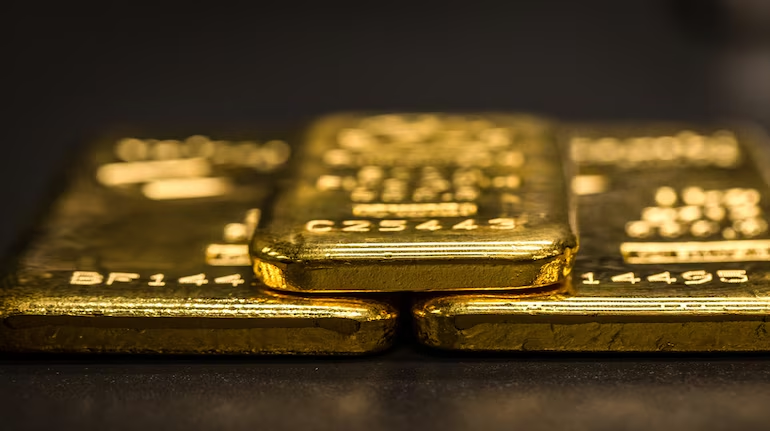
Current Gold Demand Trends in 2025-2026
The landscape of gold demand trends in 2025-2026 paints a picture of unprecedented strength. Overall, 2025 saw record demand exceeding 5,000 tonnes, with Q4 alone setting highs due to ETF inflows and central bank activity.
In the US, demand doubled to 679 tonnes, propelled by 437 tonnes in ETF additions amid geopolitical risks and rate expectations.
Sector Breakdown
- Investment: Soared 84% year-over-year to 2,175 tonnes in 2025, with US Q3 seeing +58% growth. Bars and coins are projected at 330 tonnes per quarter in 2026, reflecting FOMO and diversification.
- Jewelry: Volume weakened by 10-11% in 2024-2025 due to high prices, but value remained steady. Global consumption fell to 43.68% of total demand share.
- Technology: Softened in the US and globally amid slowdowns, holding at 7.08% share, used in electronics and dentistry.
- Central Banks: Purchased 863 tonnes in 2025, historically elevated, with 43% planning increases in 2026. Projections: 760-1,100 tonnes for 2026, among top historical years.
Regional Insights
Asia remains strong, with China retail steady despite price pressures. US ETF assets under management hit $280 billion, while North America saw exceptional flows. Emerging markets like BRICS nations bolster central bank demand.
Chart: Pie Chart of 2025 Demand Sectors
- Jewelry: 43%
- Investment: 26% (including ETFs)
- Central Banks: 24%
- Technology: 7% (Source: World Gold Council. This visual illustrates investment’s growing dominance.)
Influencing Factors
Geopolitical tensions, US dollar weakness, and Fed easing continue to drive trends. Tariff uncertainties and global conflicts enhance safe-haven appeal. 
Factors Influencing Gold Demand
Several key factors shape gold demand trends in 2025-2026, creating a powerful interplay of economic incentives, geopolitical pressures, supply constraints, and shifting investor psychology.
These elements have propelled gold to record highs, with prices surging over 60% in 2025 alone (from around $2,624/oz at the start to $4,325/oz by year-end), and continuing upward momentum into 2026 amid persistent uncertainties.
1. Economic Factors
Lower interest rates and inflation concerns remain primary drivers for gold demand. As central banks like the US Federal Reserve eased policy in 2025, borrowing costs fell, making non-yielding assets like gold more attractive compared to bonds or cash.
This boosted gold ETFs, with massive inflows—such as 437 tonnes in the US alone—pushing ETF assets under management to record levels.
Gold serves as an effective inflation hedge, preserving purchasing power when fiat currencies weaken due to rising deficits or monetary expansion.
A weaker US dollar further amplifies this effect, as gold priced in USD becomes cheaper for international buyers, spurring global demand.
Bond market uncertainty and expected rate cuts in 2026 are likely to sustain these trends, supporting continued strength in investment sectors.
2. Geopolitical Factors
Geopolitical tensions are a major catalyst for safe-haven buying.
Ongoing global conflicts, trade uncertainties (e.g., tariffs), and geoeconomic fragmentation have driven investors and institutions toward gold as a reliable store of value outside traditional financial systems.
These risks intensified in 2025, contributing to 53 all-time price highs and record investment demand.
In 2026, persistent instability— including Middle East issues and broader uncertainties—is expected to maintain elevated demand, with analysts noting that tense geopolitics will underpin strong ETF inflows, bar/coin purchases, and central bank activity.
3. Supply-Side Factors
Annual mine production remains relatively stable at around 3,000 tonnes, but total gold demand has consistently outpaced supply.
In 2025, this imbalance fueled a dramatic price rise—often cited around 34-65% depending on measurement periods—creating a feedback loop where higher prices attract more investment while constraining consumer sectors like jewelry.
Recycling provides some offset (up modestly in recent years), but not enough to close the gap, tightening the market and supporting sustained upward pressure.

Investor Behavior
Behavioral shifts play a crucial role. FOMO (fear of missing out) has driven retail and institutional buyers into bars, coins, and ETFs, especially amid diversification needs in volatile portfolios.
Central banks represent a structural change, accounting for roughly 25% of total demand in recent years through consistent accumulation.
This “structural shift” reflects de-dollarization efforts, with emerging markets diversifying reserves away from USD-heavy holdings.
BRICS nations (Brazil, Russia, India, China, South Africa, and expansions) have been key players, collectively holding significant reserves and driving over half of recent official purchases.
Positive vs. Negative Influences
Positive factors bolster demand:
- BRICS gold reserves growth and de-dollarization strategies.
- Robust central bank buying (863t in 2025; forecasts ~800t in 2026).
- Safe-haven appeal amid uncertainty.
Negative factors temper it:
- Record-high prices curb jewelry volume (down ~10% in recent years), though value holds steady.
- Potential moderation in central bank momentum if tensions ease.
- Economic shocks could reduce consumer spending.
| Factor | Impact Example | Demand Effect (2025-2026) |
|---|---|---|
| Fed Rate Cuts | +137t ETF inflows in Q3 2025; continued easing expected | Strongly Positive |
| Geopolitical Tensions | Drove 84% surge in investment demand to 2,175t in 2025 | Strongly Positive |
| Supply Shortfall | Mine output ~3,000t vs. demand >5,000t; 60%+ price rise 2025 | Positive (price support) |
| Investor FOMO & Diversification | Record ETF/bar/coin buying; central banks ~25% of demand | Strongly Positive |
| High Prices on Jewelry | Volume weakness persists; offsets some gains | Negative |
| BRICS/De-Dollarization | Emerging markets lead official sector accumulation | Positive (structural) |
These dynamics highlight gold‘s resilience. Economic easing and inflation protection encourage investment, while geopolitics and supply limits provide a floor.
Central banks’ ongoing shift—projected to absorb ~26% of mine output—adds long-term support. For investors, monitoring these factors is essential to navigate volatility.

Gold Demand Forecast for 2026 and Beyond
Looking ahead, gold demand forecasts for 2026 and the years beyond point to sustained strength, building on the record-breaking momentum from 2025 when total demand exceeded 5,000 tonnes for the first time.
Analysts from major institutions like J.P. Morgan, Goldman Sachs, and the World Gold Council (WGC) anticipate continued robust buying from central banks and investors, even as some sectors face headwinds.
This structural shift is reshaping the gold market, with demand likely outpacing supply and supporting higher prices over the medium to long term.
Projections for 2026
Central bank and investor demand is projected to average around 585 tonnes per quarter in 2026, according to J.P. Morgan Global Research.
This breaks down to roughly:
- 190 tonnes per quarter from central banks (equating to about 760 tonnes annually, a step down from 2025’s 863 tonnes but still well above pre-2022 averages of 400-500 tonnes).
- 330 tonnes per quarter in bar and coin demand.
- Additional contributions from ETFs and futures, often front-loaded.
Overall annual demand could range from 4,000 to 5,000 tonnes, potentially matching or approaching 2025 levels.
The World Gold Council expects elevated central bank purchases to persist amid geopolitical tensions, with strong ETF inflows and robust bar/coin buying offsetting any weakness in jewelry or technology.
Mine supply is likely to remain around 3,000-3,200 tonnes, with recycling stable but constrained, meaning demand will continue to strain available supply.
Price Outlook
The gold price outlook remains bullish for 2026. Base case scenarios from analysts cluster around $4,000-$5,000 per ounce, with many forecasting averages or year-end targets in the mid-$4,000s to low-$5,000s.
J.P. Morgan projects prices pushing toward $5,000/oz by Q4 2026, with potential to reach $6,300 in more optimistic views driven by persistent central bank and investor flows.
Goldman Sachs has raised targets to $5,400 by year-end, citing sustained monthly central bank buys of 60-70 tonnes.
Upside risks could push prices higher—some forecasts suggest $6,000+ or even extreme scenarios approaching $7,000-$8,700 if geopolitical risks escalate, rate cuts accelerate, or de-dollarization trends intensify.
A Reuters poll of analysts pegs the median 2026 forecast at around $4,746/oz, reflecting broad optimism amid uncertainties.
Scenarios: Bull vs. Bear
- Bull Scenario — Strong performance from China and emerging markets, coupled with heavy ETF inflows from institutional and retail investors fearing economic slowdowns or inflation. Geopolitical flare-ups (e.g., ongoing global conflicts) amplify safe-haven demand, leading to 15-30% price gains from current levels and total demand exceeding 5,000 tonnes again.
- Bear Scenario — Moderating central bank purchases (dropping toward 500-600 tonnes annually) due to stabilized geopolitics or higher opportunity costs from policy shifts. Jewelry demand remains suppressed by elevated prices, and a stronger economic recovery reduces hedging needs, potentially capping prices in the $4,000-$4,500 range with limited upside.
Even in bearish cases, structural support from diversification trends limits sharp declines.

Long-Term Outlook (Beyond 2026 to 2030)
The demand curve is shifting structurally higher. Central banks alone could absorb around 26% of annual mine output in coming years, a trend unlikely to reverse soon as emerging market reserve managers diversify away from dollar-heavy holdings.
By 2030, forecasts vary widely: conservative views see prices stabilizing around $5,500-$8,000, while bullish projections (e.g., from some AI models or extended trends) suggest $10,000-$17,000+ amid persistent inflation, debt concerns, and portfolio rebalancing.
Chart: Projected Demand vs. Price 2026-2030 (Illustrative line graph based on analyst averages)
- 2026: Demand ~4,500-5,000t, Price $5,000-$6,300
- 2027: Demand ~4,600-5,200t, Price $5,400-$7,000
- 2028-2030: Demand stabilizing 4,800-5,500t+, Price trending toward $6,000-$10,000+ (upward trajectory reflecting compounding central bank and investor demand).
(Source: Aggregated from J.P. Morgan, Goldman Sachs, World Gold Council, and consensus forecasts.)
In summary, gold demand in 2026 and beyond appears poised for resilience, fueled by institutional and official sector buying.
Investors should monitor central bank announcements and geopolitical developments closely—these will dictate whether the bull run accelerates or consolidates. For those positioning portfolios, gold’s role as a hedge remains compelling in an uncertain world.

Implications for Investors and Businesses
The robust gold demand trends in 2025-2026 present compelling opportunities for investors and businesses alike, amid sustained central bank buying (projected 760-1,100 tonnes in 2026) and strong investor inflows.
For investors, gold ETFs offer an accessible way to build diversified portfolios. With central bank and investor demand averaging around 585 tonnes per quarter, ETFs provide exposure without physical storage hassles.
Major forecasts point to gold prices reaching $5,000–$6,300 by end-2026, driven by hedging against inflation, geopolitical risks, and policy uncertainty.
Allocating 5-10% to gold ETFs can enhance portfolio resilience, especially as correlations between stocks and bonds remain elevated. Emerging options like physically backed or miner-focused ETFs are outperforming traditional ones in this environment.
Businesses, particularly jewelers and retailers, can capitalize on high prices through value marketing—emphasizing gold’s timeless appeal and cultural significance in markets like Asia.
Despite volume softness in jewelry (-10% globally), steady value demand supports premium positioning and sales growth.
Risks remain significant: volatility from policy changes (e.g., Fed shifts, US dollar strength, or accelerated economic growth) could trigger sharp corrections, as seen in early 2026 pullbacks. Geopolitical resolutions or reduced central bank appetite might cap upside.
Consider diversifying with gold investments today to hedge uncertainties—explore reputable gold ETFs or consult advisors for tailored strategies. Position early in this structural bull market for potential long-term gains.
Conclusion
In summary, gold demand trends in recent years have demonstrated remarkable resilience and structural evolution, culminating in a historic milestone in 2025.
Total global demand, including OTC, surpassed 5,000 tonnes for the first time—reaching approximately 5,002 tonnes according to the World Gold Council—fueled primarily by investment-led growth.
Investment demand surged 84% year-over-year to a record 2,175 tonnes, driven by massive ETF inflows (801 tonnes, the second-strongest year on record) and robust bar and coin purchases hitting a 12-year high.
This shift marked investment overtaking jewelry as the dominant demand category, while central bank buying remained elevated at 863 tonnes, well above historical averages despite a slight moderation from prior peaks.
Jewelry volumes weakened due to record prices, but consumer spending held firm, underscoring gold’s enduring appeal as a safe-haven asset amid geopolitical tensions, tariff uncertainties, and macroeconomic shifts.
These record demands in 2025—coupled with 53 all-time price highs and an average annual price of $3,431/oz (up 44% y/y)—signal a fundamental rebasing rather than a fleeting speculative bubble.
Looking to 2026, forecasts point to sustained strength: continued strong ETF inflows, robust bar and coin demand, and elevated (though potentially slightly lower) central bank purchases around 850 tonnes.
Analysts from J.P. Morgan project prices pushing toward $6,300/oz by year-end, with Goldman Sachs targeting $5,400/oz and others envisioning upside to $6,000+ in bullish scenarios.
As of early March 2026, spot gold trades around $5,200–$5,300/oz, reflecting ongoing volatility from geopolitical risks (including Middle East escalations) and a fluctuating US dollar, yet the underlying demand drivers remain supportive of further gains.
For investors and businesses alike, these trends highlight gold’s role as a strategic diversifier in uncertain times. Whether through ETFs for liquid exposure, physical bullion for long-term holdings, or jewelry for cultural value, positioning in gold offers protection against inflation, currency weakness, and global instability.
Stay updated on evolving gold demand trends—subscribe to our newsletter for monthly insights, price alerts, and expert analysis.
Dive deeper with related resources: explore our 2026 Gold Price Forecast Guide or Central Bank Gold Buying Trends for more data-driven strategies. Don’t miss out—consider diversifying your portfolio with gold investments today to capitalize on this ongoing bull market.