
Global Gold Reserves & Their Impact | A 2025 Economic Game Changer
Global Gold Reserves & Their Impact. In 2025, global gold reserves hit a staggering 36,700 tonnes, while gold prices surged beyond $4,000 per ounce, signaling one of the most profound shifts in modern financial history.
This unprecedented rise isn’t merely about market speculation—it reflects a global rebalancing of economic power. From Asia to Africa, nations are increasing their gold holdings as a shield against volatile currencies, inflation, and geopolitical uncertainty.
Recent years have seen a dramatic change in gold’s role within the global economy.
As geopolitical tensions intensify, particularly with Western sanctions on Russia and currency instability in emerging markets, central banks have responded by stockpiling gold at record levels.
China, India, and Turkey lead the surge, viewing gold not only as a store of value but also as a strategic weapon in global finance—a move to reduce dependence on the U.S. dollar and strengthen economic sovereignty.
This growing appetite for gold reflects more than financial prudence—it’s a geopolitical statement. Gold reserves today stabilize national economies, hedge against inflation, and influence international policy.
The higher a country’s gold holdings, the greater its leverage in times of crisis. Investors, too, are taking notice, as institutional and retail buyers increasingly turn to gold to protect their wealth from currency devaluation and market shocks.
In this article, we’ll explore how global gold reserves shape economies, drive investment trends, and redefine power dynamics in 2025.
You’ll discover how central banks use gold to build resilience, what rising reserves mean for investors, and why this ancient metal remains the cornerstone of modern finance.
By the end, you’ll understand why diversifying with gold could be the smartest move to safeguard your portfolio in an uncertain world.

Section 1: The Historical Evolution of Global Gold Reserves
1.1 From Gold Standard to Modern Reserves
The story of global gold reserves mirrors the evolution of the global financial system itself. For centuries, gold served as the backbone of monetary stability—anchoring the value of currencies under the Gold Standard.
However, the post-World War II Bretton Woods Agreement (1944) formalized a system where the U.S. dollar was pegged to gold, and other currencies were pegged to the dollar.
This arrangement maintained global economic order—until it collapsed in 1971, when President Richard Nixon ended the dollar’s convertibility to gold, ushering in the fiat currency era.
This marked a turning point. Without the gold anchor, nations relied on paper money backed only by government trust, not tangible reserves.
Yet, gold never lost its allure. Its intrinsic value and universal acceptance kept it central to monetary policy. The 2008 global financial crisis reignited interest in gold as a safe-haven asset, exposing vulnerabilities in the fiat system.
Central banks, which had once viewed gold as outdated, began rebuilding their reserves to hedge against systemic risks, inflation, and currency depreciation.
By the early 2020s, as global markets grappled with debt crises, inflation spikes, and geopolitical turmoil, gold had reemerged—not as a relic of the past, but as a strategic reserve asset underpinning trust and stability in an increasingly uncertain financial world.
1.2 Key Milestones in Central Bank Holdings
The evolution of central bank gold holdings has seen dramatic shifts over the past few decades.
During the 1990s and early 2000s, Western central banks, including those of the U.K. and Switzerland, were net sellers of gold, believing their reserves could be better utilized in bonds and foreign currencies.
However, this sentiment reversed sharply after the 2008 financial collapse.
In the 2010s, a buying spree began—driven largely by emerging economies such as China, Russia, Turkey, and India. These nations sought to diversify away from the U.S. dollar and strengthen their financial independence.
The trend only accelerated in the 2020s amid global instability. In 2024 alone, central banks collectively added over 1,000 tonnes of gold—the highest annual total in modern history.
This strategic accumulation reflects a deep-seated desire among nations to insulate their economies from external shocks, while asserting greater control over monetary sovereignty.
Transition: This history sets the stage for today’s landscape—where gold once again defines global power, stability, and financial security.
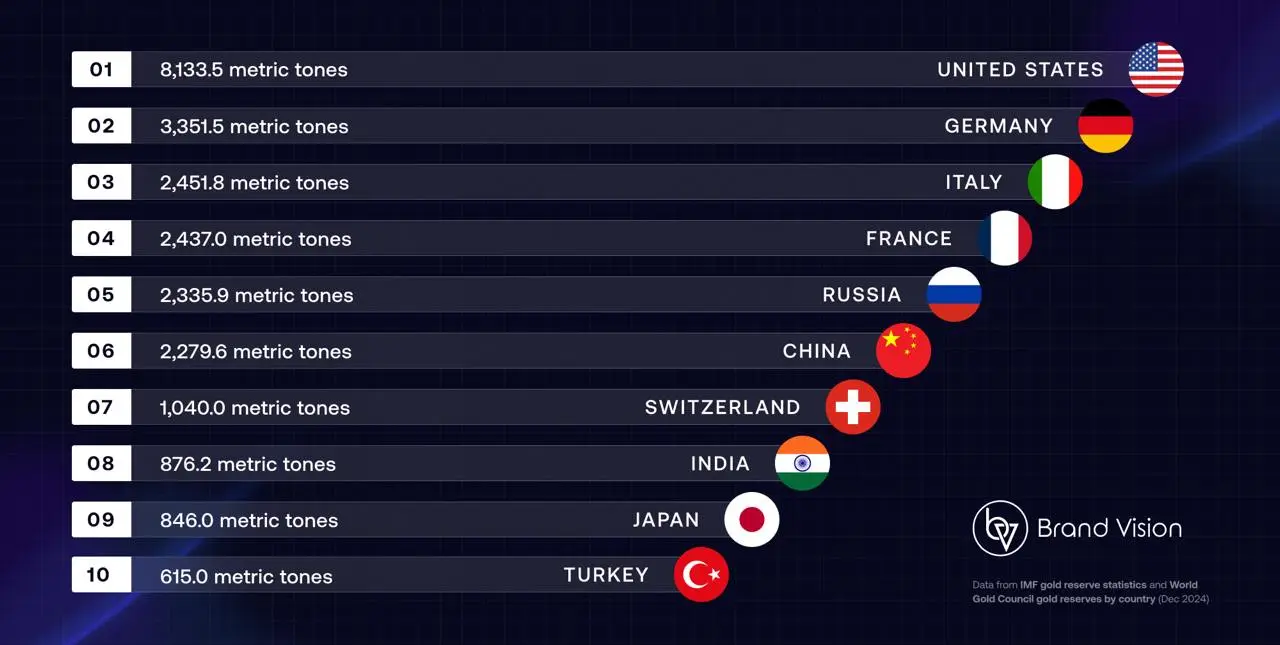
2.1 Top 10 Countries by Gold Reserves (Including Leading African Holders)
The global distribution of gold reserves by country in 2025 reveals both continuity and transformation.
While the United States continues to dominate—holding nearly 22% of the world’s total gold reserves—a new wave of emerging economies, particularly in Africa and Asia, is reshaping the balance of monetary power.
As global inflation and geopolitical risks rise, countries across the Global South are expanding their gold holdings to reinforce financial stability and assert economic sovereignty.
| Rank | Country | Reserves (Tonnes) | % of Total Reserves | Key Notes |
|---|---|---|---|---|
| 1 | United States | 8,133 | 71% | Stored primarily at Fort Knox; cornerstone of USD dominance. |
| 2 | Germany | 3,352 | 71% | Majority repatriated post-WWII; maintains long-term reserve stability. |
| 3 | Italy | 2,452 | 68% | Holdings stable since the 1990s; supports euro confidence. |
| 4 | France | 2,437 | 67% | Balances diversification and eurozone monetary stability. |
| 5 | Russia | 2,333 | 26% | Major global producer; uses gold to hedge Western sanctions. |
| 6 | China | 2,280 | 5% | Extended 18-month buying streak; diversifying from the U.S. dollar. |
| 7 | Japan | 846 | 4% | Conservative reserve policy with strategic holdings. |
| 8 | India | 803 | 9% | Combines cultural affinity with financial diversification. |
| 9 | Switzerland | 1,040 | 6% | High per capita reserve ratio; reflects financial neutrality. |
| 10 | Netherlands | 612 | 62% | Recent minor sales; maintains strategic balance. |
Meanwhile, emerging economies like China and India are steadily reshaping the global gold landscape.
Their consistent accumulation underscores a strategic pivot: reducing dependency on Western currencies and strengthening local financial systems amid global inflation and political tensions.
Russia’s 2,333 tonnes also play a key role, serving as a buffer against sanctions and economic isolation.
Collectively, these ten nations represent nearly two-thirds of all known central bank gold reserves, highlighting how gold remains the universal benchmark for economic power, even in a digitized, multi-currency world.
2.2 Trends in Central Bank Buying and Selling
Central bank behavior in 2024–2025 demonstrates a continued net buying trend, solidifying gold’s role as the world’s ultimate financial stabilizer.
Despite high prices exceeding $4,000 per ounce, nations continue to purchase gold—driven by inflation fears, currency diversification goals, and declining trust in fiat assets.
Among the most active net buyers:
-
Poland led with a remarkable +90 tonnes added in 2024, reflecting its strategy to bolster financial sovereignty within the EU.
-
Turkey, facing persistent inflation and lira depreciation, increased its holdings to restore public confidence and currency backing.
-
China maintained its 18-month accumulation streak, buying several tonnes monthly to diversify away from U.S. Treasury bonds.
On the other hand, Kazakhstan emerged as a net seller, offloading around 10 tonnes to stabilize domestic liquidity. Such small-scale selling, however, remains the exception.
The broader picture reveals a strong, synchronized global accumulation pattern, particularly across Asia and Eastern Europe. Central banks increasingly view gold not just as a crisis hedge but as a strategic reserve tool ensuring long-term resilience.
In total, global central banks added over 1,050 tonnes in 2024, marking the second consecutive record-breaking year for gold accumulation.
This trend illustrates the world’s ongoing shift toward de-dollarization and tangible asset protection—a move that reaffirms gold’s unshakable position as the cornerstone of financial stability in 2025.

Transition: These record-breaking accumulations point to deeper motives—why central banks are turning to gold as the ultimate tool for stability, protection, and power in the modern economy.
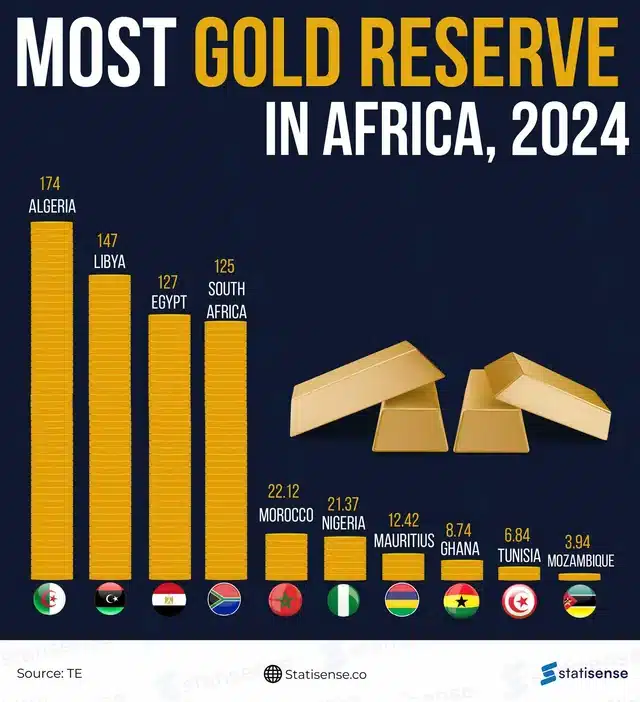
African Gold Reserve Leaders (2025 Estimates)
While African nations hold smaller reserves compared to Western economies, their influence in gold production and export markets is significant.
Several are also increasing their official gold reserves as part of a broader effort to strengthen currencies and hedge against external economic shocks.
| Country | Reserves (Tonnes) | Key Notes |
|---|---|---|
| South Africa | 125 | Africa’s largest official holder; global top 30; strong mining base. |
| Ghana | 25 | West Africa’s top gold producer; increasing reserves to back the cedi. |
| Nigeria | 22 | Expanding reserves to diversify away from oil dependency. |
| Uganda | 14 | Rising gold trade hub; leveraging regional refining and export growth. |
| Tanzania | 18 | Strengthening reserves amid rising gold export revenues. |
| DR Congo | 20 | Untapped mining potential; expected to expand reserves as output formalizes. |
| Kenya | 8 | Emerging gold producer; recently increased reserves via artisanal sector reforms. |
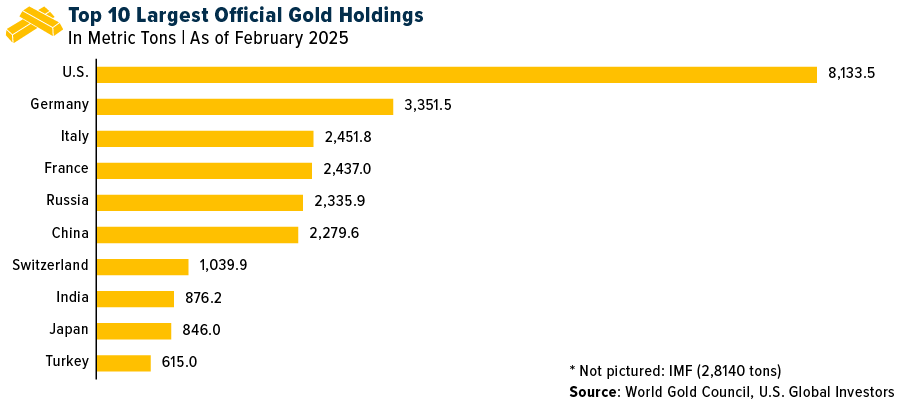
The United States remains the world’s undisputed leader with 8,133 tonnes, anchoring the U.S. dollar’s global reserve currency status.
Europe’s powerhouses—Germany, Italy, and France—collectively hold over 8,000 tonnes, ensuring gold remains central to eurozone stability.
However, the growing participation of African nations marks a turning point. With vast unmined deposits and booming export industries, countries like Ghana, Uganda, and Tanzania are now building national gold reserves to reduce dollar dependency and strengthen local currencies.
Together, these trends reflect a multi-polar shift in gold ownership. Emerging markets—from China and India to South Africa and Ghana—are not only major producers but are also asserting greater control over the world’s most reliable financial asset.
This evolution underscores a clear message: in 2025, gold remains the universal benchmark for economic power and sovereignty, even in an increasingly digital, multi-currency world.

Section 3: Economic Impacts of Gold Reserves
3.1 Stabilizing Currencies and Combating Inflation
Gold reserves serve as a critical stabilizer for national currencies, particularly during periods of market volatility and inflationary pressure.
Because gold maintains intrinsic value regardless of government policy or fiat devaluation, it acts as a hedge against currency depreciation.
When global inflation rises or fiat currencies weaken, nations with significant gold holdings tend to enjoy stronger investor confidence and more stable exchange rates.
For instance, the U.S. dollar’s global dominance is partially sustained by the country’s massive gold reserves—over 8,000 tonnes—which reassure global markets of its underlying strength.
Similarly, countries like Germany and Italy leverage gold as a monetary anchor, providing confidence in the eurozone’s fiscal stability.
Moreover, gold reserves help offset import/export imbalances. When a nation faces a trade deficit or capital flight, its central bank can utilize gold reserves to back currency interventions, sustain liquidity, or manage foreign exchange operations.
This buffering effect limits inflation spikes and currency crashes, protecting both consumers and investors from economic shocks.
In essence, gold remains the ultimate inflation shield—a timeless asset that stabilizes national economies while reinforcing faith in monetary systems during uncertain times.
3.2 Role in Financial Crises and Policy
Gold’s importance becomes most apparent during financial crises, when traditional instruments like bonds or equities lose appeal.
Following the Global Financial Crisis (GFC) of 2008, central banks worldwide dramatically increased their gold reserves as faith in paper assets waned and interest rates dropped to near zero.
Gold emerged as the safe-haven asset of last resort, maintaining purchasing power when fiat-based assets faltered.
During crises, gold reserves also serve as collateral for emergency loans or international aid packages.
For example, countries facing liquidity shortages can use their gold holdings to secure borrowing from institutions like the IMF or foreign governments.
This ability to convert reserves into credit provides vital flexibility during economic distress.
Furthermore, the strategic use of gold in monetary policy allows central banks to respond effectively to shocks. When markets become turbulent, a strong gold position enhances a nation’s credibility, helping to stabilize its financial system and currency valuation.
It also supports long-term planning by ensuring that policymakers have tangible assets to draw upon, regardless of market fluctuations.
Thus, in both calm and crisis, gold plays an indispensable role—strengthening monetary resilience, ensuring liquidity, and sustaining confidence in the global financial system.
3.3 Gold’s Share in Total Reserves
In 2025, gold constitutes roughly 18% of total global reserves, underscoring its enduring relevance despite the rise of digital assets and diversified portfolios.
This figure, however, varies significantly across nations. The United States, for example, holds about 76% of its total reserves in gold, reflecting its historic reliance on the metal to underpin the dollar’s value.
In contrast, emerging economies like China (5%) and India (9%) are still expanding their ratios as they transition from currency-heavy to asset-diversified reserve structures.
Interestingly, there’s a strong correlation between gold’s share in national reserves and GDP growth stability. Countries maintaining consistent or rising gold proportions often experience less volatility in inflation and foreign exchange rates.
This suggests that a well-balanced reserve portfolio—anchored by gold—provides not just financial security but also macroeconomic resilience.
As geopolitical uncertainty persists, nations are expected to continue raising their gold share, prioritizing tangible wealth over digital or debt-based instruments.

Call to Action:
Discover how gold can protect your wealth in volatile markets. See how gold fits your portfolio—explore our free Inflation Hedge Guide and start building financial security today.
Section 4: Geopolitical Dimensions and Global Influence
4.1 Gold as a Tool Against Sanctions and Risks
The geopolitical impact of gold reserves has never been more evident than in 2025. As economic sanctions, trade wars, and regional conflicts reshape the global order, gold has emerged as the ultimate instrument of financial independence.
Unlike fiat assets—often controlled by Western banking systems—gold exists outside the reach of sanctions, allowing nations to preserve sovereignty over their wealth.
Countries like Russia and China have led this shift. Following the 2022 escalation of sanctions on Russia due to its war in Ukraine, Moscow intensified its accumulation of gold, adding hundreds of tonnes to safeguard its currency and sustain trade through alternative financial channels.
Similarly, China—facing ongoing trade tensions with the West—has diversified away from the U.S. dollar, expanding its gold reserves to reduce reliance on dollar-denominated assets like U.S. Treasuries.
This strategy reflects a larger trend among sanctioned or risk-exposed nations: using gold as a shield against financial isolation.
Gold reserves cannot be frozen or blocked, making them ideal for maintaining liquidity and credibility in restricted financial environments.
Moreover, gold facilitates bilateral trade among non-Western economies, particularly within Asia, Africa, and Latin America, where local currencies are often unstable.
By increasing gold’s share in their reserves, these nations are effectively building parallel financial systems—ones less dependent on Western influence and more anchored in tangible, universally accepted assets.
4.2 Shifts in Power Dynamics
As the global financial order evolves, emerging markets are challenging the dominance of Western economies through aggressive gold accumulation.
The BRICS nations (Brazil, Russia, India, China, and South Africa) collectively control a rapidly expanding portion of global gold holdings, signaling a deliberate move toward de-dollarization.
This redistribution of reserves is not merely economic—it’s strategic. Gold is becoming a symbol of autonomy and a weapon of soft power.
The BRICS bloc, for instance, is exploring a gold-backed trade settlement system, reducing dependence on the dollar for cross-border transactions.
Today, nearly 40% of global gold holdings are concentrated in countries seeking to diversify away from U.S.-centric systems.
This shift highlights how geopolitical risk—driven by sanctions, inflation, and global fragmentation—is redefining alliances and accelerating the world’s transition toward a multipolar monetary landscape.
Gold, once a passive store of value, is now a lever of global influence, reshaping financial hierarchies and empowering emerging economies to challenge traditional power centers.
4.3 Future Scenarios
Looking ahead, the geopolitical impact of gold reserves will only deepen.
The continuing Ukraine–Russia conflict, along with rising tensions in the Middle East and the South China Sea, ensures that nations will further fortify their gold holdings as a hedge against global instability.
Economists also point to a potential boom in unmined reserves, estimated at nearly $7 trillion worth of gold still buried across Africa, Latin America, and Central Asia.
As technology advances and new mining partnerships emerge, these untapped deposits could shift global power once again—transferring influence toward resource-rich developing regions.
In short, gold’s role in the coming decade will expand from a financial safeguard to a strategic geopolitical asset, shaping alliances, trade systems, and economic sovereignty.
Transition: As geopolitics intertwine with economics, understanding gold’s influence isn’t just for policymakers—it’s essential for investors seeking stability in a shifting world order.
Section 5: Future Outlook and Investment Implications
5.1 Projections for 2026 and Beyond
The outlook for global gold reserves remains highly bullish beyond 2025. With persistent inflationary pressures, geopolitical uncertainty, and declining trust in fiat systems, central banks are expected to continue accumulating gold as a stabilizing asset.
Analysts forecast sustained buying momentum, especially from emerging markets and BRICS nations, which aim to fortify their monetary independence.
Projections suggest that if the current pace continues, total global reserves could surpass 37,500 tonnes by 2026, marking another historic high.
Market experts also predict that gold prices could test the $5,000 per ounce threshold, driven by tightening supply, increasing demand, and macroeconomic volatility.
Meanwhile, countries rich in untapped resources—Russia, Australia, and several African nations—are positioned to benefit immensely from the next gold exploration wave.
With an estimated $7 trillion in unmined reserves, these regions could redefine the balance of global wealth and resource power over the next decade.
5.2 Advice for Investors and Policymakers
For both investors and policymakers, the implications are clear: gold remains a cornerstone of financial resilience.
Diversification is key—experts recommend allocating 5–10% of investment portfolios to physical or paper gold, such as bullion, coins, or exchange-traded funds (ETFs).
This allocation provides a hedge against inflation, currency fluctuations, and systemic shocks. Policymakers, meanwhile, should closely monitor central bank purchasing trends as indicators of global risk sentiment.
Rising gold reserves often signal tightening liquidity or reduced confidence in fiat systems—valuable data for shaping fiscal and monetary policies.
As the world enters an era of financial realignment, gold’s dual role—as both a strategic national asset and a private wealth protector—will only grow stronger.


Transition to Conclusion: The message is clear: whether for nations or individuals, gold is not just a commodity—it’s the foundation of enduring economic strength and security.
Frequently Asked Questions on Global Gold Reserves & Their Impact
What are global gold reserves?
Global gold reserves refer to the total amount of gold held by central banks and monetary authorities worldwide. These reserves serve as a financial safeguard, helping countries stabilize their economies, support their currencies, and hedge against inflation or geopolitical risk.
Why are gold reserves important for national economies?
Gold reserves provide economic security and confidence in a nation’s currency. They act as a hedge against inflation, protect against currency devaluation, and offer liquidity during financial crises.
Which country has the largest gold reserves in 2025?
As of 2025, the United States holds the largest gold reserves—about 8,133 tonnes, representing roughly 22% of the global total. Most of it is stored in Fort Knox, Kentucky.
How do gold reserves affect global financial stability?
Large gold reserves increase a nation’s credibility in global markets, stabilize exchange rates, and support trade balances. During economic uncertainty, gold helps maintain confidence in a country’s financial system.
Why are countries like China and Russia increasing their gold reserves?
China and Russia are boosting gold holdings to diversify away from the U.S. dollar and reduce exposure to Western sanctions. Gold offers them financial independence and resilience against external economic pressures.
What percentage of global reserves is held in gold?
As of 2025, gold makes up around 18% of total global reserves, though this figure varies by country. For example, the U.S. holds about 76% of its reserves in gold, while China holds around 5%.
How does gold help during inflation or currency crises?
Gold retains intrinsic value regardless of inflation or currency depreciation. When fiat currencies weaken, gold prices often rise, making it an effective inflation hedge and store of wealth.
What role do gold reserves play in geopolitics?
Gold is increasingly used as a tool of economic sovereignty. Nations use it to bypass sanctions, trade independently, and strengthen their global influence—especially within alliances like BRICS.
Could global gold prices reach $5,000 per ounce in the future?
Analysts predict that, if current buying trends and geopolitical tensions persist, gold could approach or surpass $5,000/oz by 2026, driven by high demand and limited new supply.
How can investors benefit from global gold reserve trends?
Investors can align their portfolios with global trends by allocating 5–10% to gold (through bullion, ETFs, or mining stocks). Monitoring central bank activities offers insight into market shifts and potential price movements.
Conclusion
Gold remains the ultimate anchor of global stability and strategic power—a timeless asset that underpins currencies, fortifies economies, and reshapes geopolitical influence.
From safeguarding nations against inflation to empowering investors with tangible security, its relevance in 2025 and beyond is undeniable. As central banks expand their holdings and markets evolve, those who understand these trends will stand at the forefront of opportunity.